How Affirmations Actually Rewire Your Brain, According to Neuroscience
The Science Behind Self-Talk
For decades, affirmations were dismissed as pop psychology. But modern neuroscience tells a different story. Research using functional MRI scans has shown that self-affirmation activates the ventromedial prefrontal cortex — the same brain region involved in processing self-related information and positive valuation.
When you repeat an affirmation like "I am capable of handling challenges," your brain doesn't just hear words. It begins to build new neural pathways that support that belief.
Neuroplasticity: Your Brain's Superpower
Neuroplasticity is your brain's ability to reorganize itself by forming new neural connections throughout life. Every thought you think strengthens a neural pathway. Repeat a thought enough times, and it becomes an automatic pattern.
This is why negative self-talk is so damaging — and why replacing it with intentional positive statements is so powerful. You're literally overwriting old patterns with new ones.
What the Research Says
A landmark 2016 study published in Social Cognitive and Affective Neuroscience found that self-affirmation activates key brain reward centers. Participants who practiced affirmations showed:
- Increased activity in the ventromedial prefrontal cortex
- Reduced stress response when facing threats
- Greater openness to behavior change
- Improved problem-solving under pressure
How to Make Affirmations Work
Not all affirmations are created equal. Here's what the research suggests for maximum effectiveness:
Make them personal. Generic affirmations are less effective than ones connected to your core values. "I am worthy of love" hits harder when you connect it to specific relationships and experiences.
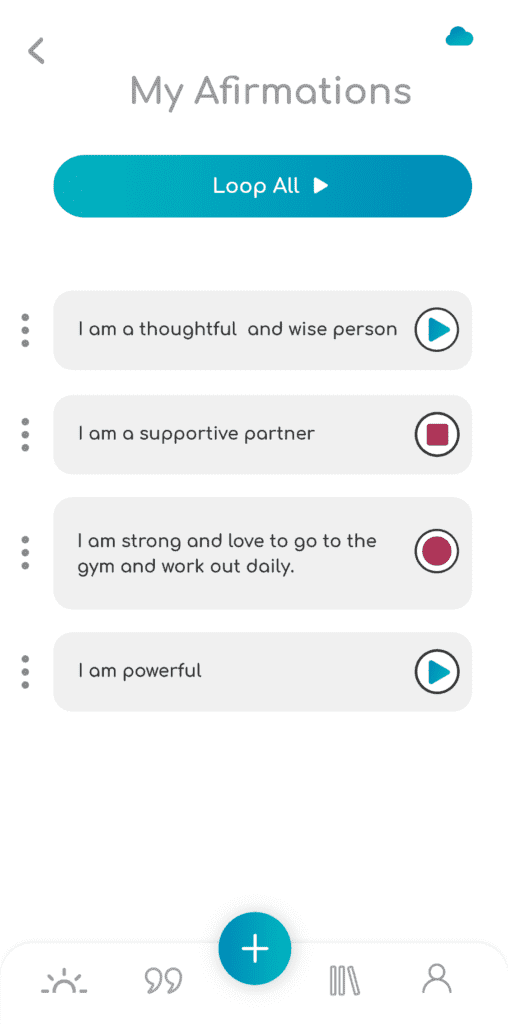
Say them out loud. Hearing your own voice adds an auditory reinforcement loop. This is why Selfpause lets you record affirmations in your own voice — your brain responds more strongly to self-generated speech.
Be consistent. Neural pathways strengthen through repetition. A daily practice of 5-10 minutes is more effective than an occasional marathon session.
Pair with emotion. Affirmations work best when you actually feel the emotion behind the words. Don't just recite — embody the feeling.
The Bottom Line
Affirmations aren't magic. They're a tool backed by neuroscience that, when used consistently, can genuinely reshape how your brain processes self-related information. The key is making them personal, consistent, and emotionally resonant.
Your brain is always changing. The question is whether you're directing that change intentionally.
Ready to start your affirmation practice?
Download Selfpause and begin transforming your mindset today.
Get Started Free