
ThinkUp Review
The affirmations app built on a powerful idea: record positive statements in your own voice and play them back.
Our rating
4.3 / 5
Starting price
Free trial, then ~$53.99/yr
Free tier
Yes
Platforms
iOS · Android
Developer
ThinkUp
Launched
2015
Our verdict
ThinkUp got the core idea right: you record affirmations in your own voice and listen back over calming music. That is the most research-aligned way to use affirmations. The library and interface feel a little dated next to newer apps, but the underlying method is the one that works.
This review is editorial and unsponsored, no affiliate payments influence our ratings. Selfpause makes a wellness app of its own, so where a product competes with us, we say so plainly and let you judge.
ThinkUp was one of the first affirmation apps to center the feature that matters most: your own voice. Instead of only reading pre-written lines, you record affirmations yourself and listen back, optionally layered over background music.
There is real logic here. Self-referential processing, hearing statements in your own voice, engages the brain differently than hearing them from a stranger, which is why voice-based practice is widely considered the strongest form.
ThinkUp executes this well, with a curated library to pull from and music to record over. The app’s design and catalog have aged somewhat as newer, voice-first competitors have arrived, but the method it pioneered remains its biggest strength.
What ThinkUp looks like


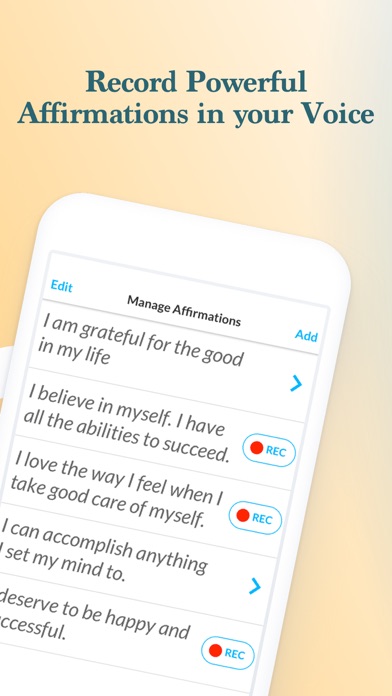


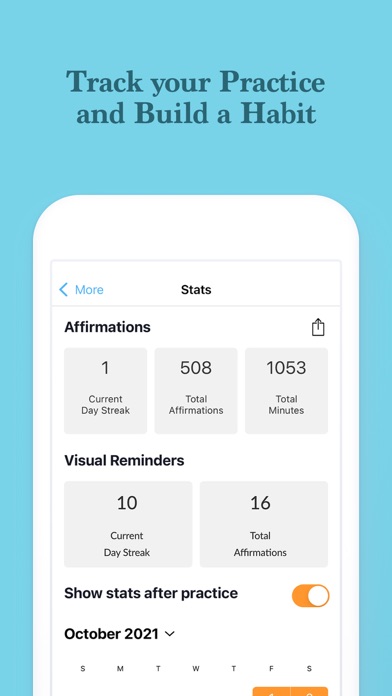
Screenshots from ThinkUp’s App Store listing, © ThinkUp.
Pros & cons
What we like
- Record affirmations in your own voice, the most effective way to use them.
- Layer recordings over background music for a more immersive listen.
- A solid starter library of affirmations to record or adapt.
- Simple daily-listening habit loop.
- Reasonable price for a voice-based practice.
What we don’t
- Interface and library feel dated compared with newer voice-first apps.
- Mixing and layering options are basic.
- Free tier is quite limited.
- Less polished discovery and personalization than category leaders.
Best for / avoid if
Best for
- →People who want to hear affirmations in their own voice
- →Anyone who finds pre-recorded affirmations impersonal
- →Those who like listening during commutes or workouts
- →Users who value method over a flashy interface
Avoid if
- →You only want passive widgets and notifications
- →You want the most modern, polished design and mixing tools
- →You want guided meditation rather than affirmations
Pricing
Free
$0
A limited set of affirmations and recording features.
Premium
~$53.99/yr
Full library, unlimited recordings, and music layering.
What ThinkUp is
ThinkUp is an affirmations app whose central feature is recording affirmations in your own voice and playing them back, optionally over calming music.
It is an active, audio-first practice rather than a passive text feed, you participate in creating the thing you listen to.
Why your own voice matters
ThinkUp’s whole premise is that hearing an affirmation in your own voice is more persuasive to your brain than reading it or hearing it from someone else. The practice becomes personal and self-directed.
This is the feature that separates serious affirmation tools from decorative ones. Recording takes a little more effort up front, but it is precisely that effort that gives the practice its power.
Self-voice recording
Record any affirmation in your own voice and add it to a daily playlist.
This is the heart of the app and its strongest claim to effectiveness. It turns affirmations from something you skim into something you genuinely say to yourself.
Music layering
Play your recordings over calming background tracks for a more immersive listen.
It is a nice touch that makes daily listening pleasant, though the mixing controls are simpler than what newer apps offer.
Where ThinkUp falls behind
Modern polish. The interface and catalog feel older than the newest voice-first apps.
Mixing depth. Layering and personalization are basic compared with purpose-built mix engines.
Discovery. Finding and organizing affirmations is less smooth than in category leaders.
ThinkUp vs. I Am vs. Selfpause
All three target the same goal differently. I Am is passive and widget-driven. ThinkUp and Selfpause both center recording in your own voice, the more powerful approach, with Selfpause adding deeper mixing and a more modern experience.
If you are sold on the own-voice method, the decision is really between ThinkUp and a newer voice-first app. ThinkUp proved the concept; the newer apps refine the experience around it.
Pick I Am if you only want lock-screen positivity; pick a voice-recording app if you want the practice that research most supports.
Bottom line
ThinkUp pioneered the most effective affirmation method, your own voice, and still does it competently. If you want that method in a more modern, deeply customizable experience, compare it against newer voice-first apps before subscribing.
Want a daily positivity practice in your own voice? Selfpause lets you record personalized affirmations, layer them with calming music, and keep them on your lock screen.
Try Selfpause FreeAlternatives to ThinkUp

I Am
4.4The passive, widget-first affirmations app.
Read our review →

Calm
4.5For guided meditation rather than affirmations.
Read our review →

Insight Timer
4.6A huge free library that includes affirmation tracks.
Read our review →
Frequently asked questions
What makes ThinkUp different?+
It centers recording affirmations in your own voice and playing them back over music, the most research-aligned way to practice affirmations.
Is recording affirmations in your own voice actually better?+
Many find it far more effective. Hearing statements in your own voice engages self-referential processing more strongly than reading them or hearing a stranger.
ThinkUp or I Am?+
ThinkUp if you want an active, own-voice practice; I Am if you want passive widgets and notifications.
Is ThinkUp free?+
There is a limited free tier; recording without limits and the full library require Premium.
A note on mental health: apps and online services can support wellbeing, but they are not a substitute for professional care. If you are struggling, a licensed professional can help, and if you are in crisis, contact your local emergency number or, in the US, call or text 988 (Suicide & Crisis Lifeline).
More affirmation apps reviews

Selfpause
4.6Our own app, reviewed with full disclosure, affirmations recorded in your voice, layered with music, kept on your lock screen.
I Am
4.4The widget-first affirmations app that made positive self-talk a glanceable daily habit.

Gratitude
4.3A warm three-in-one: gratitude journal, affirmation player, and vision board in a single daily ritual.