
Headspace Review
The most structured way to actually learn meditation, friendly, progressive, and beginner-proof.
Our rating
4.5 / 5
Starting price
Free trial, then $69.99/yr
Free tier
Yes
Platforms
iOS · Android · Web
Developer
Headspace Inc.
Launched
2012
Our verdict
Headspace is the best app for genuinely learning to meditate. Its courses are progressive, warmly narrated, and beginner-proof. If you want to be taught, not just handed a library, it is the strongest pick. Calm still wins on sleep, and Insight Timer wins on free breadth.
This review is editorial and unsponsored, no affiliate payments influence our ratings. Selfpause makes a wellness app of its own, so where a product competes with us, we say so plainly and let you judge.
Headspace, founded by former Buddhist monk Andy Puddicombe, made meditation approachable for millions by treating it like a course rather than a content dump. Its signature animations and calm, friendly narration turned an intimidating practice into something a complete beginner could stick with.
Where Calm spreads across sleep, music, and relaxation, Headspace stays anchored in teaching mindfulness well. You move through structured packs that build on each other, so you are not just pressing play, you are progressing.
It has since added solid sleep content, focus music, and short "moment" exercises, and it powers many workplace mental-health benefits through Headspace for Work (which absorbed Ginger’s coaching). For most individuals, though, the draw is still the teaching.
What Headspace looks like

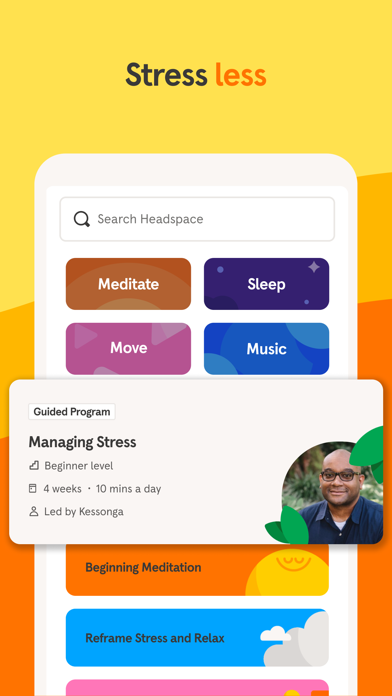


Screenshots from Headspace’s App Store listing, © Headspace Inc..
Pros & cons
What we like
- Best-in-class structured courses, packs build skills progressively, which is ideal for beginners.
- Warm, consistent narration that makes the practice feel guided rather than left to you.
- Clean, friendly design with signature animations that explain concepts simply.
- Good breadth beyond meditation, sleepcasts, focus music, and quick SOS exercises.
- Backed by published research and widely used in workplace mental-health programs.
What we don’t
- The free tier is minimal, essentially a tour of the basics.
- Annual price (~$69.99) sits at the premium end of the category.
- Less sleep depth than Calm, good, but not Calm’s catalog.
- The single-teacher style is comforting to some and monotonous to others.
Best for / avoid if
Best for
- →Total beginners who want to be taught meditation step by step
- →People who like structure and progress over an endless library
- →Anyone who bounced off meditation before and needs a gentle on-ramp
- →Employees whose company offers Headspace as a benefit
Avoid if
- →Your main goal is sleep, Calm is stronger there
- →You want a huge free catalog, Insight Timer is the better value
- →You dislike a single narrator’s voice and want lots of teachers
Pricing
Free trial
$0
A limited set of basics plus a trial of the full library.
Headspace
$69.99/yr
Full access to courses, sleepcasts, focus music, and exercises.
Monthly
$12.99/mo
Same access billed monthly, more flexible, more expensive over a year.
What Headspace is
Headspace is a guided meditation and mindfulness app organized around structured courses. You pick a topic, stress, sleep, focus, anxiety, and work through a sequence of sessions that build on each other.
It is designed first for people who do not yet know how to meditate, with teaching baked into every session rather than assumed.
Why beginners stick with Headspace
Headspace treats meditation as a skill to be taught, not a library to browse. Each pack introduces one idea, reinforces it, and adds the next, so progress feels structured instead of random.
That scaffolding is exactly what most beginners need. The reason people quit meditation is usually "I do not know if I am doing it right", and Headspace answers that question constantly.
Structured course packs
Themed multi-session courses, Basics, Managing Anxiety, Sleep, Focus, that progress in difficulty.
This is the core of the product and its biggest edge. Following a path beats picking random sessions when you are still learning what works for you.
Sleepcasts and wind-downs
Roughly 45-minute narrated audio designed to ease you toward sleep, plus shorter wind-down exercises.
They are good and growing, but if sleep is your single biggest reason to subscribe, Calm’s catalog is deeper.
Where Headspace falls behind
Sleep depth. Calm simply offers more, and more famous, sleep audio.
Free value. Insight Timer’s free catalog dwarfs anything Headspace gives away.
Variety of voices. The consistent narration is a feature for some and a limitation for others.
Headspace vs. Calm vs. Insight Timer
Headspace is the teacher, Calm is the sleep specialist, and Insight Timer is the free megastore.
If you have never meditated and want to learn properly, start with Headspace. If your real problem is sleep, start with Calm. If you want maximum content for free, start with Insight Timer.
Headspace and Calm cost about the same, so the decision usually comes down to a simple question: do you want to be taught meditation, or do you mostly want to sleep?
Bottom line
Headspace is the best on-ramp to meditation there is. Choose it if you want structure and teaching. If sleep is your priority, choose Calm; if free breadth is, choose Insight Timer.
Want a daily positivity practice in your own voice? Selfpause lets you record personalized affirmations, layer them with calming music, and keep them on your lock screen.
Try Selfpause FreeAlternatives to Headspace

Calm
4.5The sleep-and-relaxation pick with unmatched Sleep Stories.
Read our review →

Insight Timer
4.6The largest free meditation library anywhere.
Read our review →
Frequently asked questions
Is Headspace good for beginners?+
It is arguably the best app for beginners. The structured Basics course teaches you what to do and why, session by session.
Headspace or Calm?+
Headspace if you want to learn meditation through structured courses; Calm if your main goal is better sleep and relaxation.
Is there a free version of Headspace?+
There is a free trial and a small set of basics, but the full library requires a subscription.
Does Headspace help with anxiety?+
It has dedicated courses for stress and anxiety and is supported by published research, but it is a wellness tool, not treatment for a clinical anxiety disorder.
A note on mental health: apps and online services can support wellbeing, but they are not a substitute for professional care. If you are struggling, a licensed professional can help, and if you are in crisis, contact your local emergency number or, in the US, call or text 988 (Suicide & Crisis Lifeline).
More meditation apps reviews
Insight Timer
4.6The largest free meditation library in existence, more content than you could finish in a lifetime.
Calm
4.5The most polished sleep and meditation app on the market, and priced like it.

Waking Up
4.5Sam Harris’s meditation app, as much a course in the nature of mind as a meditation library.