
Recovery Record Review
The treatment-team companion, recovery-oriented logging that your clinician actually sees.
Our rating
4.4 / 5
Starting price
Free for individuals
Free tier
Yes
Platforms
iOS · Android
Developer
Recovery Record Inc.
Launched
2011
Our verdict
Recovery Record is the standard-bearer for eating disorder recovery apps: meal, thought, and feeling logs designed around recovery (no calorie counts, no weight focus), syncing directly with your therapist or dietitian between sessions. Free for individuals, clinically informed, and widely used in real treatment. It works best as what it was built to be, a bridge to a professional team.
This review is editorial and unsponsored, no affiliate payments influence our ratings. Selfpause makes a wellness app of its own, so where a product competes with us, we say so plainly and let you judge.
Most food apps are recovery hazards, calorie counters and weight graphs are the disorder’s native tools. Recovery Record inverted the genre: logs capture what you ate descriptively, alongside thoughts, feelings, and urges, with affirming feedback instead of numbers.
Its defining feature is the clinician link. Your treatment team, therapist, dietitian, physician, sees your logs in their portal, spots patterns, and leaves feedback between appointments, turning the loneliest hours of recovery into observed, supported ones.
Built with clinical researchers and refined across a decade of real treatment use, it is free for individuals. Used solo it still offers recovery-safe structure and coping skills, but its full value, like recovery itself, arrives with a team. If you need one, the National Alliance for Eating Disorders helpline can help you find care.
What Recovery Record looks like
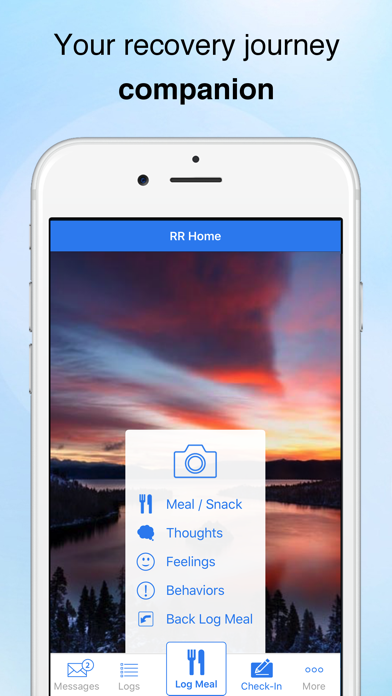
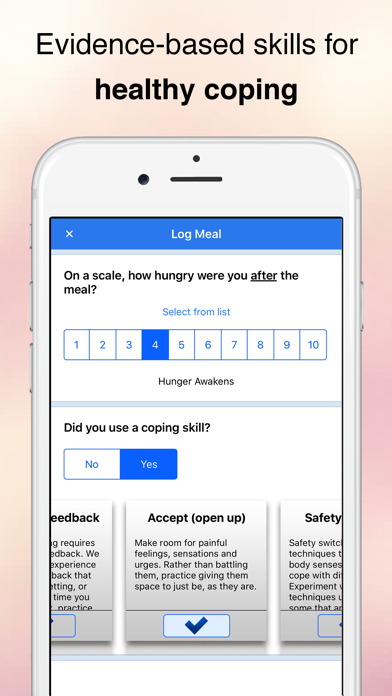
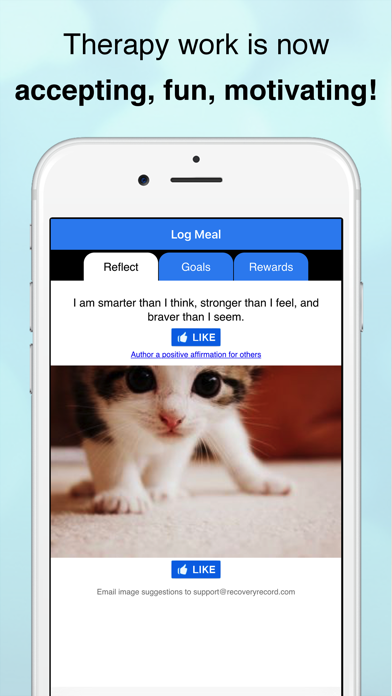
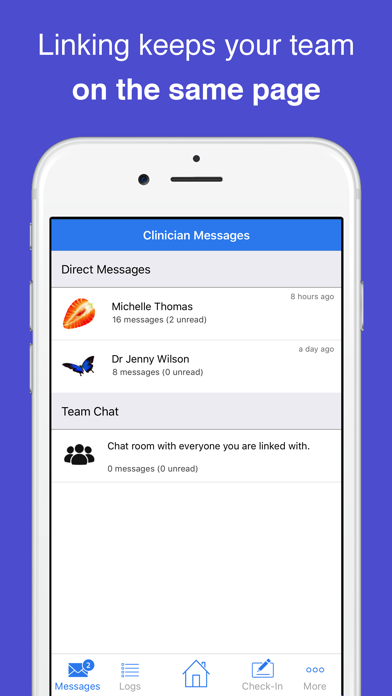
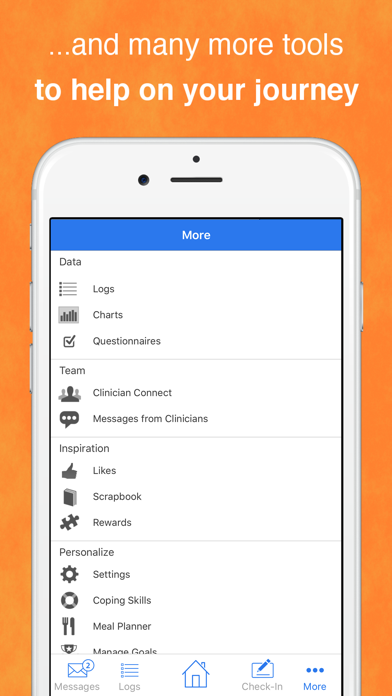
Screenshots from Recovery Record’s App Store listing, © Recovery Record Inc..
Pros & cons
What we like
- Recovery-safe by design, no calories, no weights, no diet residue.
- Direct sync with your treatment team between sessions.
- Logs thoughts, feelings, and urges alongside meals.
- Coping skills and affirmations at vulnerable moments.
- Free for individuals; a decade of clinical refinement.
What we don’t
- Deepest value requires a treatment team to connect with.
- Logging meals can itself feel triggering early on, pace with your clinician.
- Interface is functional rather than beautiful.
- Solo use leaves its best feature idle.
Best for / avoid if
Best for
- →Anyone in active eating disorder treatment
- →Patients whose teams support app-linked monitoring
- →People stepping down from higher levels of care
- →Self-monitoring between weekly appointments
Avoid if
- →You are seeking weight or intake tracking, that is anti-recovery here, deliberately
- →You have no treatment team and want community instead, Rise Up may fit alongside
- →You are medically unstable, eating disorders can be emergencies; seek care now
Pricing
Individuals
Free
Full logging, skills, and clinician-linking.
Clinician side
Practice plans
Treatment teams subscribe to the monitoring portal.
What Recovery Record is
Recovery Record is an eating disorder recovery app for logging meals, thoughts, and urges in a recovery-safe format, with direct syncing to your professional treatment team.
It is clinical homework infrastructure, the space between appointments, made visible and supported.
Why the clinician link changes recovery
Eating disorders live in unobserved hours; weekly sessions sample a fraction of the week. Team-visible logging closes that gap, your dietitian sees Tuesday’s skipped lunch on Tuesday, not next Friday.
For patients, being seen between sessions is both accountability and comfort: the recovery is witnessed exactly where it actually happens.
Recovery-safe logging
Meals recorded descriptively with emotions, thoughts, and urges, never calories or weights.
The format itself is therapeutic positioning: food as experience to be understood, not arithmetic to be won.
Treatment-team sync
Clinicians view logs, track patterns, and send feedback through their portal.
This is the moat, no other ED app integrates into real treatment this deeply.
Where Recovery Record falls behind
Solo ceiling. Without a linked team, you hold its best feature unused.
Community. No peer layer, Rise Up covers that side.
Polish. Utility design, showing its clinical origins.
Recovery Record vs. Rise Up + Recover
The two pillars of ED recovery apps: Recovery Record is the clinical bridge, Rise Up the self-help-and-community companion. They answer different questions, "how do I work with my team?" versus "how do I get through this afternoon?"
In active treatment, Recovery Record is the natural primary, with Rise Up as supplemental support. Without a team yet, start with Rise Up, and let finding professional care be the next step it supports.
Either way: apps assist ED recovery; treatment drives it.
Bottom line
Recovery Record is the definitive treatment-companion app for eating disorder recovery, recovery-safe logging your team actually sees, free to you. Pair it with professional care; that pairing is the product.
Want a daily positivity practice in your own voice? Selfpause lets you record personalized affirmations, layer them with calming music, and keep them on your lock screen.
Try Selfpause FreeAlternatives to Recovery Record

How We Feel
4.5Gentle emotion tracking alongside recovery.
Read our review →

Finch
4.7Shame-free self-care companionship.
Read our review →
Frequently asked questions
Does Recovery Record count calories?+
No, deliberately. Logs are descriptive and feeling-centered. Numeric tracking is the disorder’s tool, and the app refuses it on clinical grounds.
Do I need a treatment team to use it?+
No, solo use is free and useful, but the clinician sync is its defining strength. If you are unsupported, the National Alliance for Eating Disorders helpline can help you find specialist care.
Is it really free?+
For individuals, yes, clinician practices pay for the monitoring portal side.
Can an app treat an eating disorder?+
No. Eating disorders carry serious medical risk and need specialist treatment. Apps like this support that treatment between sessions, that is their honest, valuable role.
A note on mental health: apps and online services can support wellbeing, but they are not a substitute for professional care. If you are struggling, a licensed professional can help, and if you are in crisis, contact your local emergency number or, in the US, call or text 988 (Suicide & Crisis Lifeline).