
Sleepio Review
Not a relaxation app, a clinically validated CBT-for-insomnia program in digital form.
Our rating
4.6 / 5
Starting price
Often free via employer or health plan
Free tier
No
Platforms
Web · iOS
Developer
Big Health
Launched
2012
Our verdict
Sleepio is in a different category from every other app on this list: a structured digital CBT-I (cognitive behavioral therapy for insomnia) program with randomized controlled trials behind it. It treats insomnia rather than soothing it. Access is mostly through employers and health systems, if yours offers it, take it before buying any soundscape subscription.
This review is editorial and unsponsored, no affiliate payments influence our ratings. Selfpause makes a wellness app of its own, so where a product competes with us, we say so plainly and let you judge.
Most sleep apps help you relax; Sleepio retrains how you sleep. Built by Big Health with sleep scientist Colin Espie, it delivers a six-week CBT-I program, the first-line clinical treatment for chronic insomnia, through a virtual coach, weekly sessions, and a sleep diary.
CBT-I works differently from soundscapes: techniques like sleep restriction, stimulus control, and cognitive restructuring rebuild the association between bed and sleep. Sleepio’s program has been validated in multiple randomized controlled trials, genuine clinical evidence, not wellness marketing.
The catch is access: Sleepio is primarily distributed through employers, insurers, and health systems (including parts of the NHS) rather than as a cheap consumer download. Check your benefits first, many people have it free without knowing.
What Sleepio looks like
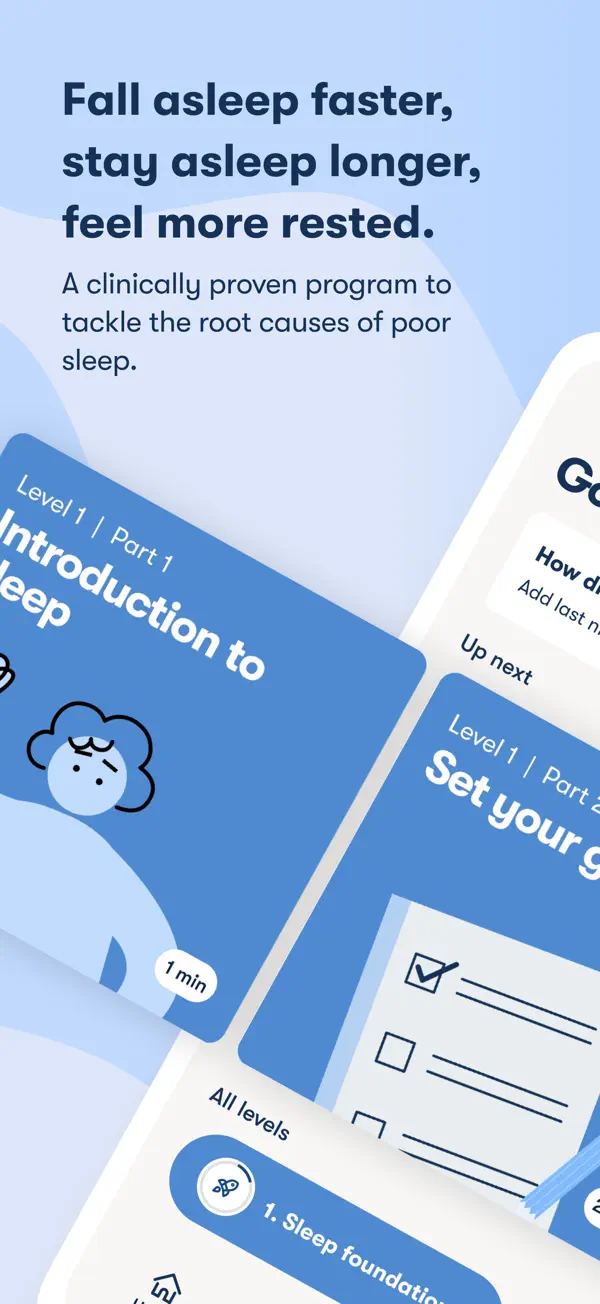
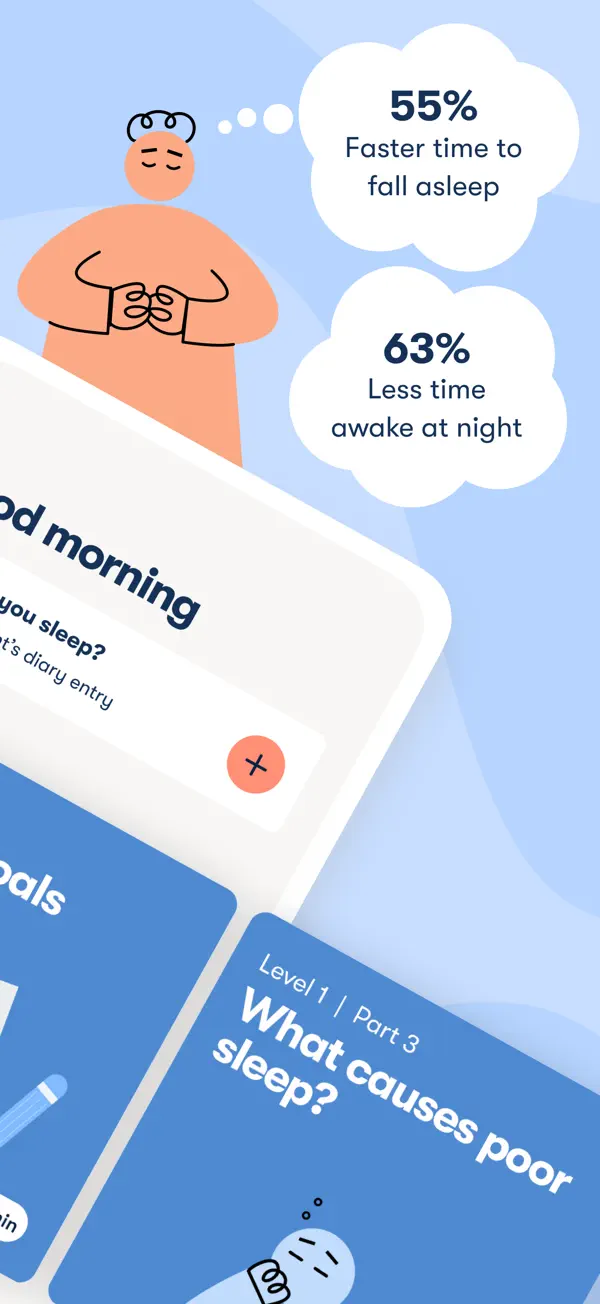
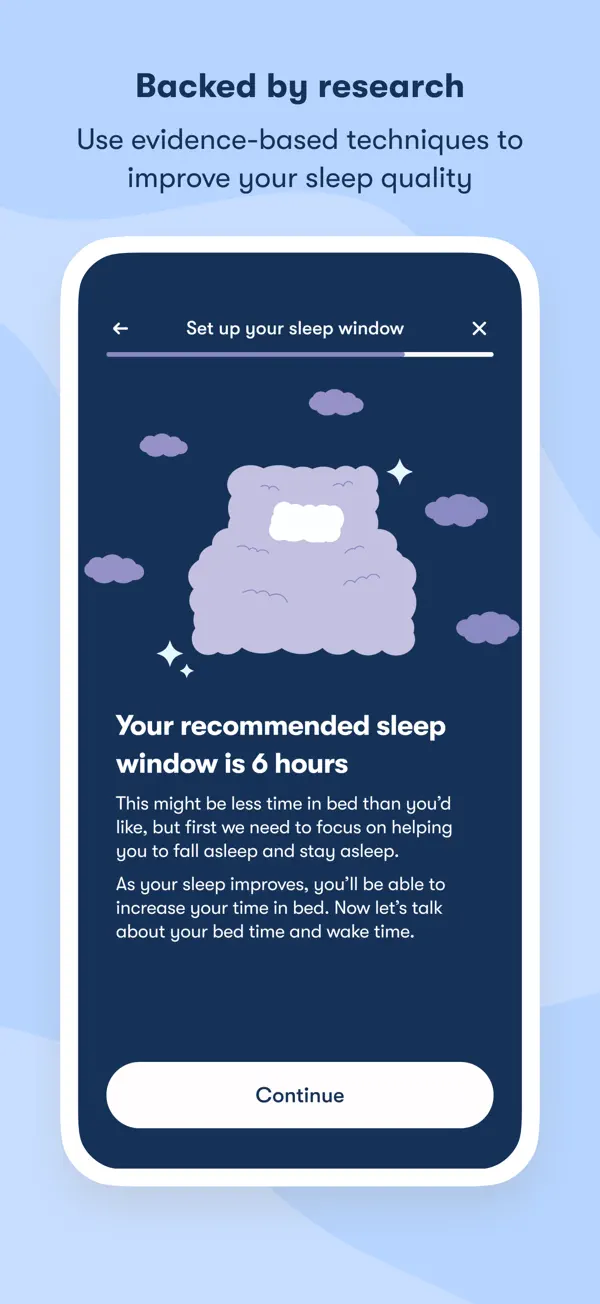


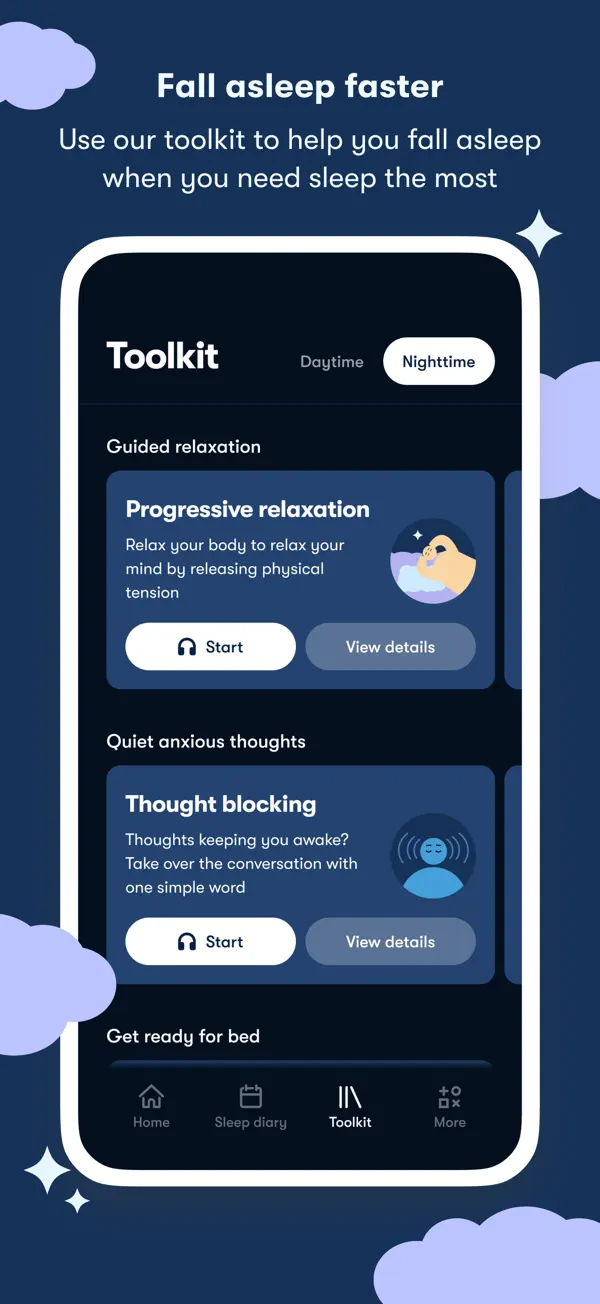
Screenshots from Sleepio’s App Store listing, © Big Health.
Pros & cons
What we like
- Real CBT-I, the first-line clinical treatment for chronic insomnia.
- Validated in randomized controlled trials, rare for any app.
- Structured six-week program with a virtual coach and sleep diary.
- Often completely free through employers, insurers, or health systems.
- Treats the root pattern instead of masking it nightly.
What we don’t
- Limited direct-to-consumer access; availability depends on your benefits.
- Demanding, sleep restriction is genuinely hard for a few weeks.
- Not a relaxation app; no soundscapes or stories to enjoy.
- Web/iOS focus; experience is more clinical than cozy.
Best for / avoid if
Best for
- →People with chronic insomnia, not occasional bad nights
- →Anyone whose employer or health plan includes Sleepio
- →Those who have cycled through soundscape apps without lasting change
- →People who want evidence over ambience
Avoid if
- →You sleep fine and just like falling asleep to audio, BetterSleep or Calm
- →You cannot access it through a benefit and find consumer access closed
- →You are unwilling to follow a demanding program for several weeks
Pricing
Via benefits
Free
Through participating employers, insurers, and health systems, the main route.
Direct
Varies
Consumer access is limited and varies by region; check sleepio.com for current options.
What Sleepio is
Sleepio is a digital CBT-I program: six structured weeks of sleep restriction, stimulus control, and cognitive techniques delivered by a virtual coach with a sleep diary.
It is a clinical-grade treatment program for insomnia in app form, not an ambience or relaxation product.
Why CBT-I beats soundscapes for insomnia
Chronic insomnia is maintained by conditioning, bed becomes associated with wakefulness and worry. CBT-I systematically breaks that loop, which is why clinical guidelines recommend it before sleep medication.
Sleepio digitized the protocol faithfully and then proved it in trials. For true insomnia, that makes it worth more than every soundscape app combined.
The six-week program
Weekly interactive sessions with a virtual coach set techniques and adjust your sleep window from diary data.
The structure is the treatment: each week builds on logged results, exactly like clinician-delivered CBT-I.
Sleep diary and sleep-window scheduling
Daily diary entries drive personalized sleep restriction, temporarily compressing time in bed to rebuild sleep pressure.
It is the hard, effective core of CBT-I; expect rough early weeks and meaningfully better sleep after.
Where Sleepio falls behind
Access. Distribution through benefits means many readers simply cannot buy it.
Comfort. There is nothing cozy here, it is treatment, with treatment’s demands.
Casual use. For occasional restlessness, gentler apps serve better.
Sleepio vs. Calm vs. BetterSleep
Calm and BetterSleep help you drift off tonight; Sleepio changes how you sleep permanently. They are different tools for different problems.
Occasional trouble switching off → soundscapes and stories. Chronic insomnia, months of bad nights, dread of bedtime, → CBT-I, and Sleepio is its best digital form.
Check your employee benefits before paying for anything; Sleepio free through work beats every subscription in this category.
Bottom line
Sleepio is the most clinically serious sleep product on this list, real treatment, really proven. If you have chronic insomnia and any benefits route to it, start there; keep the soundscape apps for afterward.
Want a daily positivity practice in your own voice? Selfpause lets you record personalized affirmations, layer them with calming music, and keep them on your lock screen.
Try Selfpause FreeAlternatives to Sleepio

BetterSleep
4.3Soundscapes for falling asleep tonight.
Read our review →

Calm
4.5Premium sleep stories and relaxation.
Read our review →

Sleep Cycle
4.3Tracking and gentle wake-ups.
Read our review →
Frequently asked questions
What is CBT-I?+
Cognitive behavioral therapy for insomnia, the first-line clinical treatment, using sleep restriction, stimulus control, and cognitive techniques to retrain sleep. Sleepio delivers it digitally.
Is Sleepio really evidence-based?+
Yes, it has been validated in multiple randomized controlled trials, which is genuinely rare for a digital health product.
How do I get Sleepio?+
Mostly through employers, insurers, and health systems. Check your benefits portal; direct consumer access is limited and varies by region.
Sleepio or Calm?+
Different problems: chronic insomnia → Sleepio; occasional trouble unwinding → Calm. Many people eventually use both.
A note on mental health: apps and online services can support wellbeing, but they are not a substitute for professional care. If you are struggling, a licensed professional can help, and if you are in crisis, contact your local emergency number or, in the US, call or text 988 (Suicide & Crisis Lifeline).
More sleep apps reviews
Sleep Cycle
4.3The veteran sleep tracker and smart alarm that wakes you in your lightest sleep phase.
BetterSleep
4.3The soundscape-first sleep app, formerly Relax Melodies, with a generous free tier.

Endel
4.2The adaptive soundscape engine, AI-generated audio that reshapes itself to your time, weather, and heart rate.